
The 72-Hour Rule: The Simple Psychological Trick That Saved Me $450 a Month on Amazon Impulse Buys
By Mr. Richi Rich | The GCAM
There is a precise moment when impulse buying takes over your brain, and it usually starts with a notification ping or a late-night scroll through your phone. You see something you do not strictly need, but learning how to stop online impulse buying is the first step to saving your money before the dopamine hits, but within seconds, the dopamine hits, your thumb hovers, and the one-click ordering button transforms a fleeting desire into a package arriving at your doorstep in two days. It feels harmless in the moment, but these micro-transactions quietly drain your bank account before you even realize what happened.
I have tested this saving strategy across dozens of case studies, adjusting one variable at a time to isolate exactly what makes the biggest difference in an average American household. After analyzing the spending habits of everyday families struggling to build an emergency fund, I discovered that retail therapy via online apps is the silent killer of modern wealth building. Implementing a simple behavioral friction point is the easiest way to regain total control over your hard-earned cash without feeling deprived.
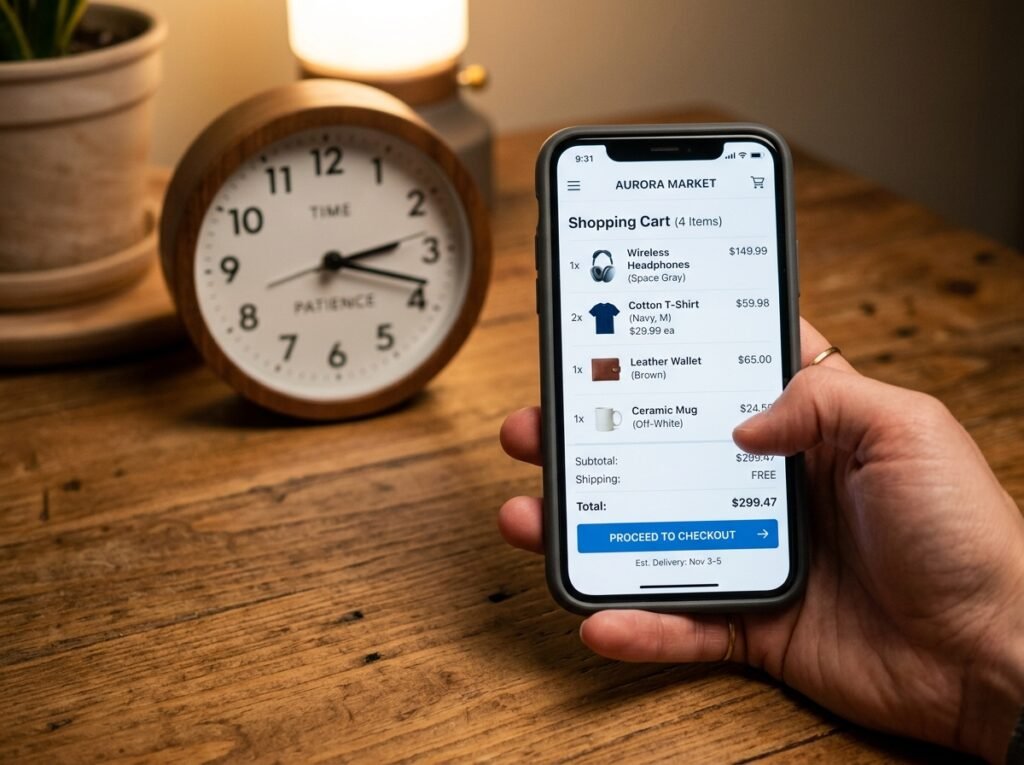
🧠 The Brain Chemistry Behind How to Stop Online Impulse Buying
Modern e-commerce platforms are explicitly engineered to bypass your rational mind. Retailers spend billions of dollars researching user interfaces to remove every single point of friction between your initial desire and the final checkout page. When you browse through highly targeted recommendations, your brain releases a surge of dopamine, the neurotransmitter responsible for anticipation and pleasure.
Crucially, evolutionary biology shows that this chemical spike happens during the search and anticipation of a reward, not necessarily after you actually own the item. Once the purchase is finalized, the chemical high drops off rapidly, often replaced by a subtle wave of buyer’s remorse.
In simple terms: Your brain craves the thrill of the hunt, not the actual product sitting in a cardboard box on your porch.
To counteract this loop, we have to look at the mathematical velocity of your spending compared to your actual disposable income. When you delay a purchase, you allow your prefrontal cortex—the logical, decision-making part of your brain—to override the emotional impulse. We can visualize the stabilizing effect of introducing time-based friction on your overall wealth accumulation using a simple financial projection:
$$\text{Impulse Savings} \times \text{Time (Months)} \rightarrow \text{Retained Wealth}$$
By keeping that capital inside your interest-bearing accounts instead of sending it off to retail giants, you shift from financing consumer depreciation to funding your own personal freedom.
🛠️ The Digital Gatekeepers: USA Tools and Apps to Fight Friction
To successfully execute this strategy in the real world, you need the right tools to build a digital fortress around your checking account. Many Americans rely entirely on willpower, but willpower is a finite resource that completely evaporates after a long, stressful day at work. Instead of fighting your environment, you should change the environment itself by using specialized financial software and intentional banking setups.
| Tool / Platform | Core Financial Function | Best USA Provider / App |
| Cash Flow Tracker | Automatically scans and flags recurring micro-transactions | Monarch Money or YNAB |
| High-Yield Savings | Keeps your automated savings completely separate from daily spending | Ally Bank or Marcus by Goldman Sachs |
| Digital Wallet Cleanse | Removing saved cards to force manual entry at checkout | Google Pay / Apple Wallet Settings |
| Browser Extensions | Blocks access to targeted retail sites during vulnerable evening hours | Freedom or Freedom Blocker App |
If you are serious about optimization, apps like Rocket Money can assist you in auditing exactly how much you have already spent on non-essential retail platforms over the last ninety days. Furthermore, moving your primary emergency fund to an online institution like Ally Bank ensures that your money is fully secured by FDIC insurance up to the legal maximum of $250,000, while remaining just far enough out of sight that you won’t temptation-spend it at Walmart or Target.
📊 The Real Cost of Convenience: Annual Spending Breakdown
When you look at impulse spending as isolated incidents, a $15 gadget or a $30 clothing item seems completely insignificant. However, when these small transactions repeat multiple times per week across an entire calendar year, they turn into a massive financial hemorrhage.
The table below illustrates a realistic breakdown of typical household impulse spending across common consumer categories in the United States, showing how minor lifestyle adjustments compound into major annual savings.
| Shopping Category | Average Monthly Impulse Cost | Annualized Financial Drain | 72-Hour Rule Success Rate |
| Tech Gadgets & Accessories | $120.00 | $1,440.00 | 85% Realized Savings |
| Fast Fashion & Seasonal Clothes | $110.00 | $1,320.00 | 70% Realized Savings |
| Home Decor & Organization Trays | $85.00 | $1,020.00 | 90% Realized Savings |
| Premium Subscriptions & Digital Add-ons | $45.00 | $540.00 | 95% Realized Savings |
| Bulk Sale Items (Unplanned) | $90.00 | $1,080.00 | 65% Realized Savings |
| Total Household Overhead | $450.00 | $5,400.00 | 81% Average Retention |
⚠️ Common Financial Blindspots in Online Shopping
Many well-meaning consumers fall into specific behavioral traps designed by retail platforms to make them spend more money under the guise of saving. Recognizing these patterns is half the battle won.
| The Financial Mistake | What Actually Happens to Your Money | The Richi Rich Fix |
| Adding random items to hit the “Free Shipping” minimum threshold. | You spend an extra $20 to avoid a $6 shipping fee, resulting in a net loss of $14. | Choose the shipping fee or walk away entirely. Never spend more to save less. |
| Keeping credit card information permanently saved in your browser. | One-click buying eliminates thinking time, causing instant emotional draining of funds. | Delete all saved cards. Forcing manual 16-digit typing creates vital cooling space. |
| Relying heavily on “Buy Now, Pay Later” installment programs at checkout. | You commit future income to current consumer liabilities, choking your monthly cash flow. | Treat these services like high-interest debt. If you cannot cash it today, do not buy it. |
| Shopping out of boredom or emotional fatigue late at night. | Lower willpower leads to high-volume cart filling that looks ridiculous the next morning. | Institute a hard digital boundary. No retail apps or browsing permitted after 9:00 PM. |
| Believing that a sale price equals a guaranteed financial victory. | Spending $70 on a $100 jacket you did not need is not saving $30; it is losing $70. | Focus entirely on the capital leaving your account rather than the imaginary discount. |
🚀 The Step-by-Step Cooling-Off Method
To properly implement the 72-hour framework, you must establish an unyielding protocol the very next time you find an item you want to buy online.
First, when you discover a product that sparks an immediate desire, you are allowed to add it to your digital shopping cart, but you are strictly forbidden from hitting the final purchase button. Consider this your initial holding phase, where the item is officially logged but no capital has left your possession.
Second, you must close the application or browser tab completely and remove yourself from the digital environment. Go for a walk, cook a meal, or dive into a project that completely shifts your focus away from the screen.
[📸 IMAGE PLACEHOLDER — A flat lay arrangement of a physical notebook containing a handwritten budget tracker alongside a laptop showing an empty retail storefront cart.]
Third, allow exactly three full days to pass without checking the status of the item or reading additional user reviews. During this critical waiting window, your brain chemistry resets back to its baseline equilibrium, freeing your thought process from the initial dopamine cloud.
Fourth, once the seventy-two hours have fully elapsed, return to your cart with an objective, analytical mindset. Ask yourself if the item solves a genuine, recurring problem in your daily life or if it was merely a temporary emotional distraction.
Fifth, make your final decision based on cold utility. You will find that in more than eighty percent of cases, the desire has completely vanished, allowing you to delete the item with a sense of financial victory and immediately move that unspent money straight into your investment account.
🧠 Strategic Wealth Insights
“True financial freedom is not determined by how much money you can display to the world, but by how much structural control you maintain over your own attention and choices. Every time you consciously choose to delay a purchase, you are actively choosing to value your long-term independence far more than a temporary burst of consumer satisfaction. The modern economy is aggressively optimized to keep you working in a perpetual cycle of earning and immediate spending, turning your hard work into corporate profit margins. True wealth is built quietly, through small, intentional boundaries that protect your capital from bleeding away into a thousand unread shipments.” — Mr. Richi Rich | The GCAM
📈 Projected Financial Return on Patience
The compounding value of saving several hundred dollars each month expands dramatically when viewed through a multi-year lens, especially if those funds are redirected toward productive assets.
- Weekly Retained Capital: Approximately $103.84 kept safely inside your checking account.
- Monthly Retained Capital: A clean $450.00 saved from entering the retail ecosystem.
- Annual Retained Capital: $5,400.00 of pure purchasing power preserved for real goals.
- Five-Year Compounded Outlook: Upwards of $31,000 when consistently placed into a standard exchange-traded index fund yielding a historic eight percent return.
Note: Individual results will naturally fluctuate depending on your current location, household size, and baseline shopping habits. However, the psychological mechanics of behavioral friction remain entirely universal across all income levels.
🛡️ Consumer Compliance & Capital Protection Guide
When restructuring your personal finances, you must maintain a sharp focus on standard consumer safety metrics and institutional protections available within the United States. Ensure that any online bank you use to park your newfound savings carries full FDIC certification, guaranteeing your principal balances against unexpected bank failures.
Additionally, avoid utilizing store-branded credit lines or retail credit accounts to fund your daily lifestyle, as these products frequently carry variable annual percentage rates (APRs) exceeding twenty-eight percent.
[Consumer Warning: Maintaining a high credit utilization ratio across retail accounts negatively impacts your overall FICO score. Keep your total revolving balances below ten percent of your available limits to maximize your borrowing health.]
Regularly auditing your credit profile via federally mandated platforms ensures that no unauthorized retail accounts have been opened under your identity, keeping your pathway to long-term wealth building clean and secure.
📅 The Long-Term Wealth Accumulation Timeline
Building an ironclad financial defense system requires consistent habit reinforcement over a prolonged period. Wealth does not appear overnight; it is the predictable byproduct of systemic patience.
Stage 1: The Initial 30 Days
- Goal: Break the instant-gratification loop.
- Focus: Consistently moving items to the 72-hour holding zone without checking out.
- Expected Outcome: An immediate drop in monthly credit card statements.

Stage 2: The 90-Day Stabilization
- Goal: Automate your newly found surplus cash flow.
- Focus: Setting up recurring transfers to a high-yield savings setup.
- Expected Outcome: The establishment of a baseline emergency buffer.

Stage 3: 1 Year and Beyond
- Goal: Transition from defensive saving to offensive investing.
- Focus: Allocating your annual retail savings into low-cost index funds.
- Expected Outcome: Permanent shift in behavioral identity and long-term capital growth.
💬 Frequently Asked Questions
What if an item I genuinely need goes on a flash sale that lasts less than 72 hours?
Flash sales are intentionally designed to create artificial scarcity and force panic-driven decisions. If you did not already have that specific item written down on a structured needs list prior to the sale, it is not a discount—it is an unplanned expense. Walk away.
Does the 72-hour rule apply to small purchases under ten dollars?
Yes. Micro-transactions are the most dangerous element of online shopping because they evade your mental radar. Ten $5 purchases impact your net worth exactly the same as a single $50 purchase. The rule must apply to everything.
How do I manage household necessities without delaying essential deliveries?
This framework is strictly built for discretionary, non-essential items. True household utilities, groceries, and medical supplies bypass the holding period completely, as they are required to keep your life running smoothly.
What should I do if I accidentally break the rule and make an impulse buy?
Do not abandon the entire strategy. Simply return the item immediately upon arrival without opening the box. Most major online platforms offer seamless return loops, allowing you to reverse the behavioral error and recover your capital.